Available in The Hague, The Netherlands: (27th of November 2025 – 14th of December 2025) Sis Josip Galerie Art Mart Hoogstraat 9
Available in The Hague, The Netherlands: Page Not Found Boekhorststraat 102
Available in Stockholm, Sweden: Papercut Shop Krukmakargatan 24-26
Available to be read in Amman, Jordan: lesser amman library 30 Othman Bin Affan Street, Jabal Amman
Available in Cairo, Egypt: Falak Book Store 7 Gamal Al Din Abou Mahasen, Garden City
Available in Alexandria, Egypt: The Alexandria Deli 27 Ismailia St. Kafr Abdo
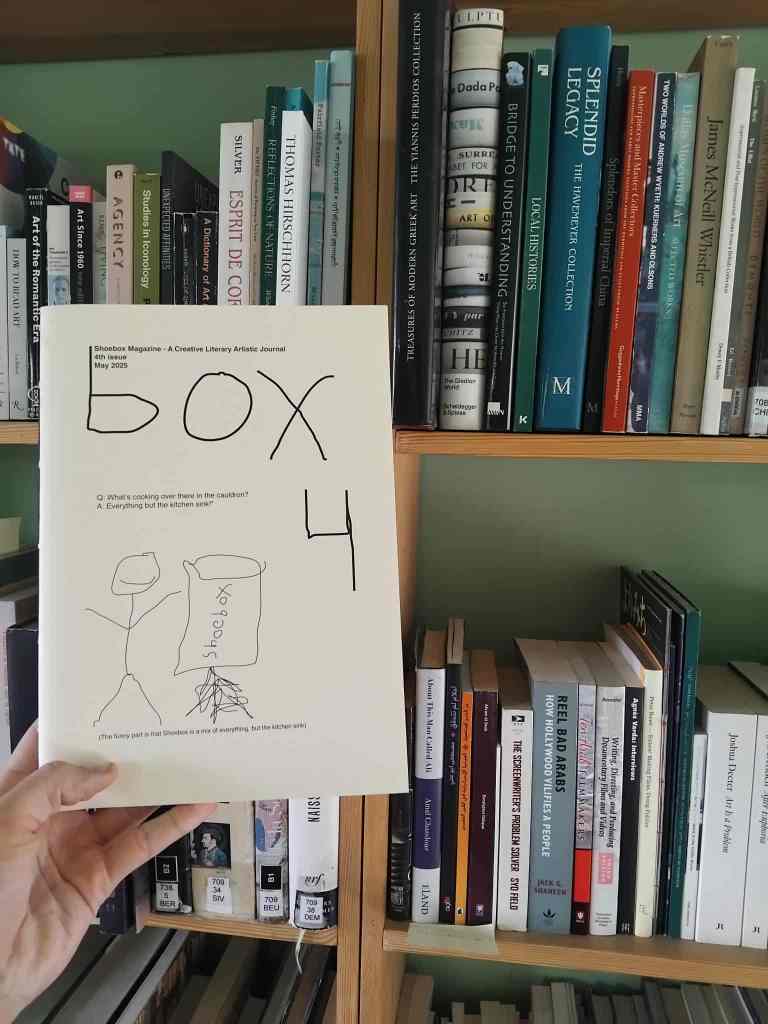
Introduction to the fourth issue by Dennis Farnsworth:
This fourth issue of Shoebox Magazine is a big turning point, not only for whatever Shoebox is, but also for myself. In December, I participated in the Cairo Art Book Fair, coming up to which I was scared shitless as to what in the world I was doing there. Showing this magazine, let alone selling it to someone for actual money, takes a lot of faking it till you make it, which is exacerbated tenfold when I make use of this platform to get in touch with people for potential interviews, or articles. The question I have is: What is Shoebox and why does it give me the authority to preserve someone’s thoughts and hard work?
I don’t think it does, or that it necessarily needs to. The amount of submissions that came in, along with thoughts and ideas from a variety of different people, make me think that perhaps this magazine can just be, and that it already is.
So far, I’ve been using these questions as fuel to do something, rather than just lying around thinking about it, which was also the idea to begin with. With that, Shoebox becomes an art project that is constantly in motion and evolving – making mistakes and learning – so putting a certain label to it would feel redundant.
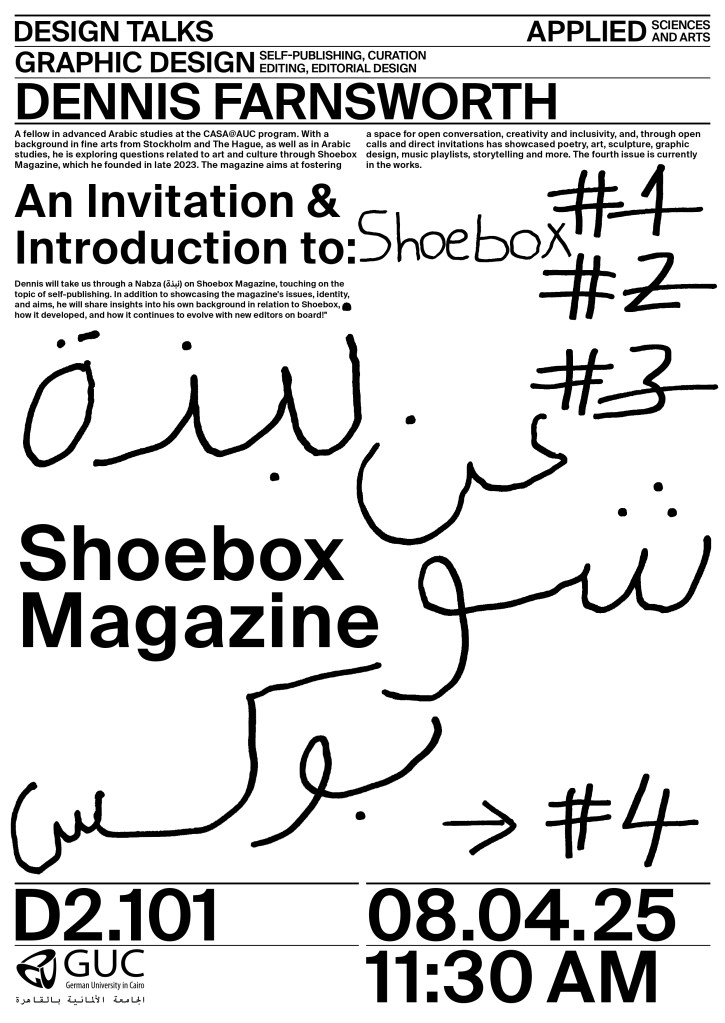
At the book fair, I met Rana Wassef, who invited me to do a small lecture at the German University in Cairo. Then I met Felix František, from the Shelter Art Space in Alexandria, who invited me to host a Shoebox Evening in collaboration with his artist residency. Once again, I had no idea what I was doing, and I don’t know if either of those happenings were successes. However, through those encounters, a new person or two actually got interested enough in this project to contribute with their thoughts and hard work, which is showcased here in this issue.
What’s striking to me is how kind people are, and understanding, which goes especially for the two new editors, Lumi Androvic Muzio and Omnia Najem, who have helped tremendously going over submissions and sharing ideas.
There’s a certain… responsibility, or liability, that you take upon yourself when you create a magazine. Sending and answering e-mails, going back and forth with contributors and everyone else involved, to make sure that it’s all on point. One of the most difficult parts has been the sad reality of printing costs, which led to the unfortunate fact that we had to decline submissions. That ties into the question of
professionalism and the handling of someone else’s work, time, and effort. What authority do we, I, have to pick and chose – curate?
There’s always a typo that gets missed, or a photo that isn’t given proper justice when printed on paper. Even writing in a third language, which for me is Arabic, missing nuances that don’t sound as good in Arabic as they might do in English. All you can do is work hard and learn, step by step, which goes both on a personal level and also on the level of the magazine. That is the essence, and I hope it shows in this fourth Shoebox between your hands.
And I mean, a typo isn’t that bad in the grand scheme of things. The third issue of Shoebox – the one before this one – featured a list of life rules*. The third of those rules might apply here: “3: There are no good or bad news. Only news. Except when it’s very bad.”
Lumi, in one of our conversations, said that “Shoebox is putting the finger to the pulse of what people are thinking right now,” which in turn begs even more questions. What people? And what pulse? All of that is impossible for me to answer. The questions, like the magazine, just are.
Like past issues, this one brings together a wide range of thoughts, poetry, and small and big tid-bits of information, and working on it has been inspiring and exciting. I hope that it is equally pleasurable to be a reader. Welcome.
*Life rules by RAMA, Kimia Khedri, Jacobus Benning, Tom von Allsop. (P.121 – P.124, Shoebox #3)
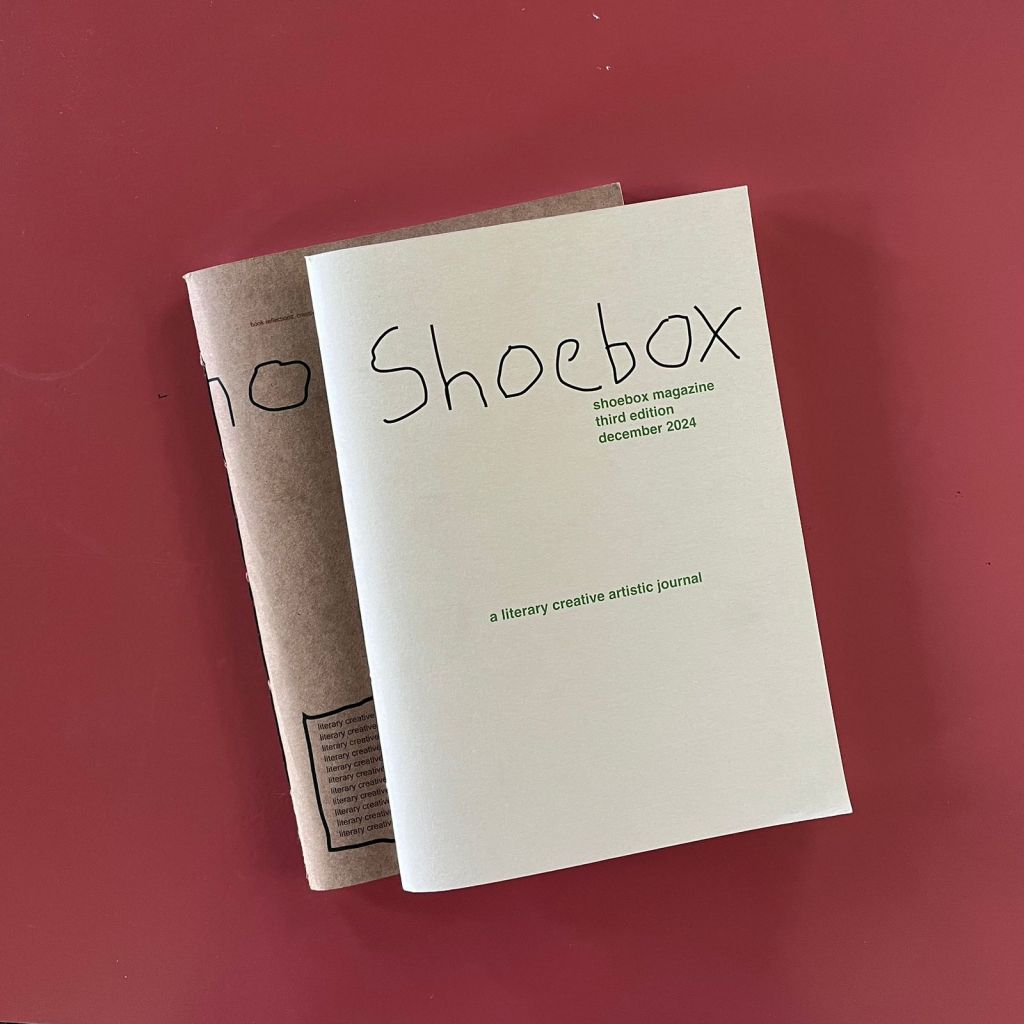
Shoebox Shoebox Shoebox. A literary creative artistic journal.
One of the biggest fears I had prior to starting a fellowship in Arabic studies and leaving the comfort of an art academy was how to confront people and places I find interesting – for Shoebox – as someone who is an artist or creator with an idea worth sharing. And to play the game of making it seem like I know what I’m on about in relation to magazines and self-publishing enough for someone else to be interested in participating.
It’s a scary thing because not only are you putting yourself out there, but also exposing your goals and ideas which more often than not feel completely unbased.
What is Shoebox?
It’s a solo-project (for now) with the core idea of gathering creativity and stories from a variety of people to share in a common space: of community and openness.
But then what does it do? I question if it’s just some paper with some names and some words bound together with a string. But at the same time those questions could be directed at anything in the world. Isn’t Shakespeare also just some words on paper?
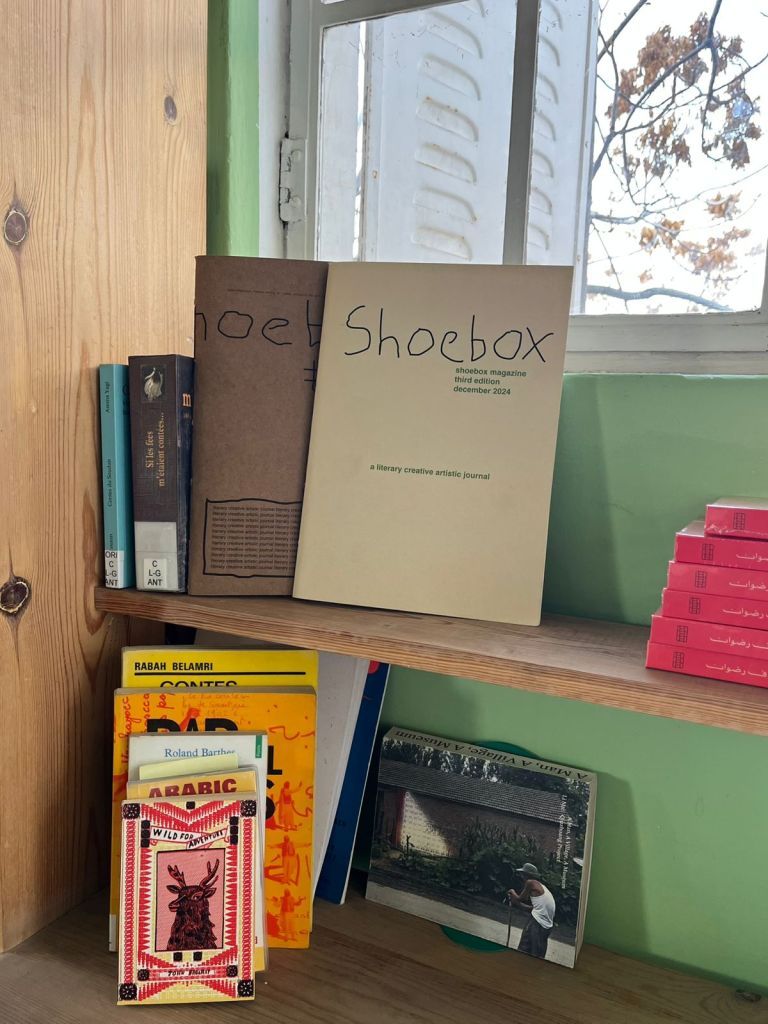
The amount of submissions for this issue is both rejuvenating and surprising. Through an open call, direct invitations and interviews, the third edition of Shoebox is filled with poetry, essays, creative writing, illustration, painting and more, from many contributors that I have never even met.
And all of the sudden slogans like anti-elitism, inclusivity and openness feel less pressing than in previous issues. All submissions that have been sent have been included in this edition, because how can I make judgement and say what gets in to a magazine that aims at community and openness?
More present now and in relation to this magazine is trying to grapple with the themes of art and society and how they complement each other. If the connection is tangible or if it even needs to be at all.
The way I see it is that striving towards openness and community in art can be a vicious circle, especially in relation to Shoebox. This magazine is already going at it from a point of fellowships and art academies which could be seen to many as the literal definition of elite. I was reading about the Egyptian surrealist ‘Art and Freedom’ movement in ‘The Dawn of Egyptian Modern Painting’ by Najib Ezz El-Din, and this comment felt uncomfortably relevant to my thoughts:
“In fact, the “Art and Freedom” movement was – in spite of its loud social slogans – secluded from reality. /…/ They spent daytime in drawing surrealistic pictures, and issuing statements that denounced the ‘’Bourgeois”. At night, they displaced their pictures at the most elegant salons and galleries, which were unfamiliar to the public /…/. They represented the thinking of the elite in its ivory tower. And though hating this class, they appealed to it, because it was the only class that cared for their art.” (118)
Eslam Safwat Makadi, who is contributing with a reflectional piece about the process of writing his book ‘Our Truth’ in this issue, expressed during our first meeting how existential he found the previous edition of Shoebox to be. That many of the submissions reflected a search for something that perhaps isn’t tangible at all.
It is then these constant questions that are driving this magazine forward at a time when things feel as though they are turning upside down.
One the other hand, trying to measure the effect in whatever material way may be missing the whole point. Working on the story about the community arts center Darb1718 for this edition, I was inspired and calmed by how organic this connection feels there. One thing just kind of leads to the other and the beauty is doing it together.
Like previous editions of Shoebox, this number three is a collective word-of-mouth effort spanning a variety of languages, with contributors from many corners of the world. There is no theme by which a contribution has to follow, which is a purposeful decision in order to give space to the individual contributor and their specific work, idea, piece or contemplation.
There is also the important-to-mention fact that my own ramblings in this introduction may be completely unrelatable to a contributor in this magazine. This is done intentionally to further enable the open space that Shoebox is trying to facilitate, as well as to once again raise the point of how one can strive to open a non-hierarchical and inclusive platform.
In the end, Shoebox is about questioning, open dialogue, storytelling and cultural exchanges.
Available in The Hague, The Netherlands: (27th of November 2025 – 14th of December 2025) Sis Josip Galerie Art Mart Hoogstraat 9
Available in Stockholm, Sweden: Rönnells Antikvariat Birger Jarlsgatan 32B
Larrys Corner Grindsgatan 35
Available in The Hague, The Netherlands: Page Not Found Boekhorststraat 102
Available to be read in Cairo, Egypt: Available to be read in the library of the Contemporary Image Collective (CIC): Etehad El-Mohamein El-Arab Street 2, Garden City/ ٢ شارع اتحاد المحامين العرب (الطلمبات سابقًا)، الدور الثاني، جاردن سيتي، القاهرة.
Available to be read in Amman, Jordan: Lesser Amman Library, at the MMAG Foundation Othman Bin Affan Street 30
To be showcased at the third edition of Cairo Art Book Fair 12, 13 and 14th of December 2024
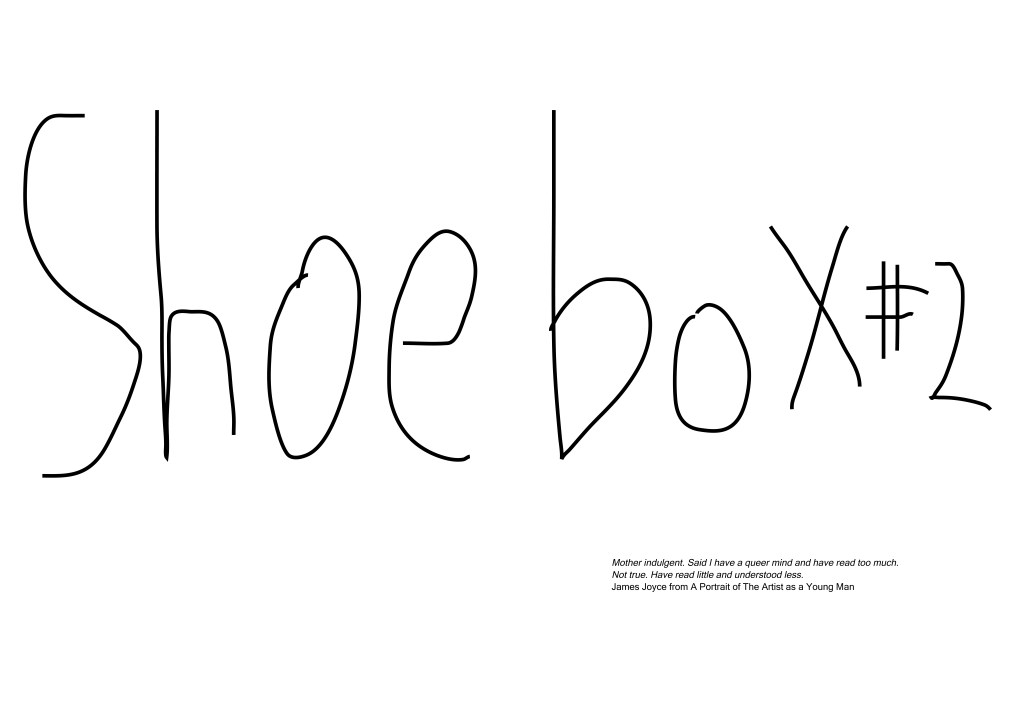
Open PDF Access to the 2nd edition click on photo below
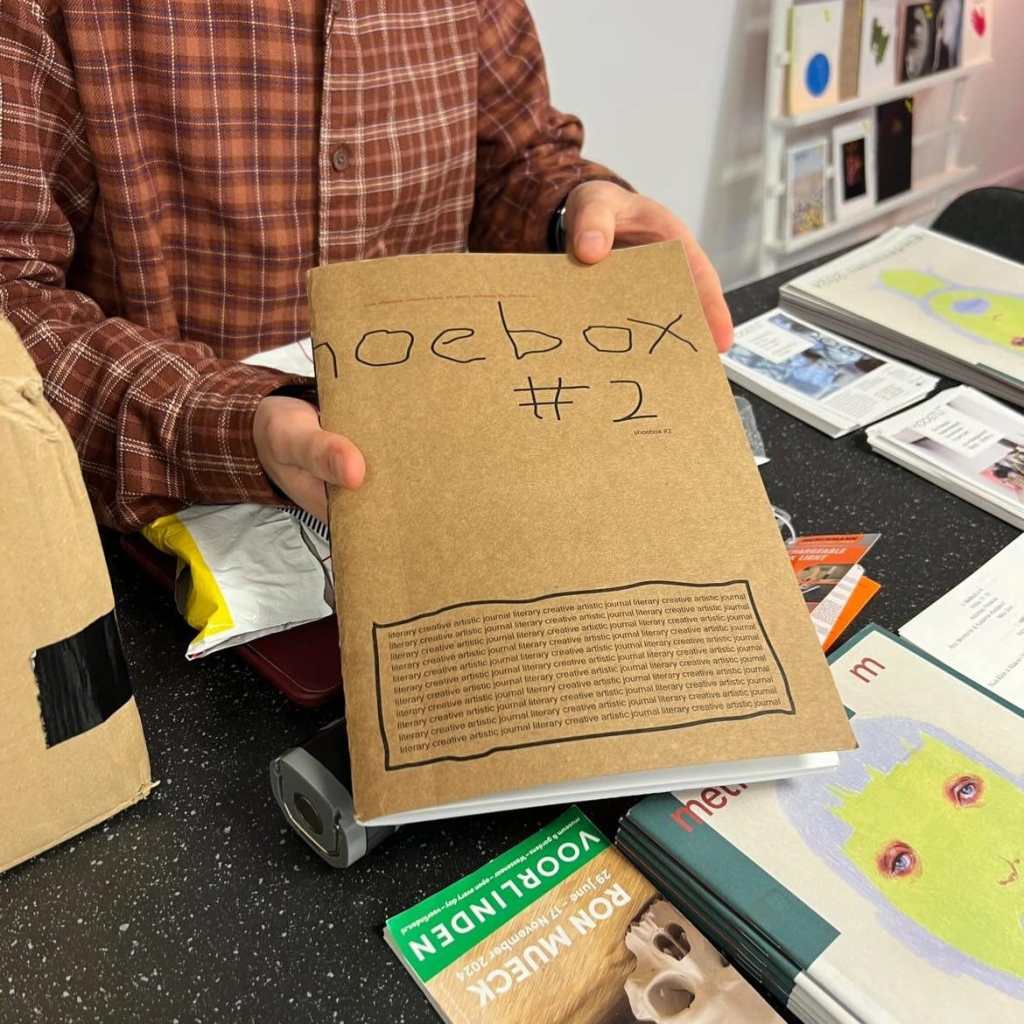
Introduction to the 2nd edition:
Shoebox is on a trip this year: from Bachelor of Fine Arts in The Hague to fellow in Advanced Arabic Studies in Cairo. The contrast is stark, not only in terms of language and culture, but also on a personal level. After four years in safe-space art schools I find myself engaging with academics, students of law, politics and other worldly – real – pursuits. Few doubt the relevance or the hard work that goes in to these things, compared to a degree in fine arts which to many is seen as pointless and the epitome of privilege.
In this new and different environment I find myself questioning the importance of art and perhaps more so the importance of studying it. It’s becoming difficult to hold on to and justify because what I am doing now is so far removed from what I have done for the past four years.
People around me drop names of presidents I’ve never heard of and discuss political issues in countries I’ve never heard of. Important things. The world is fucked and things need to be solved, discussed. Can art be a part of that? Is it even its place to be?
As part of the fellowship we got to meet the great Salwa Bakr who said, among other things, that a writer’s main job is to live life fully, because without rich life experiences what could a writer have to say? It stayed in my mind hearing it from someone like her, especially after being schooled away from romantic ideas of art for so long.
Art is the most beautiful thing in the world – the essence of being in which our souls meet: any art student in the schools I’ve been would be laughed at saying something like that.
But it’s true, what can a writer (artist) have to say if they haven’t lived life and seen things? Is that why the bohemian counter-culture lifestyle has become a trend that many, perhaps myself included, adhere to despite having been grown up under relatively safe and comfortable circumstances? An aesthetic that makes one feel that they belong in the world of troubled artists and literates.
I wanted to follow up and ask Bakr about what living life fully means in relation to studies based on self-expression. Is studying art – self-expression – for years and years really living life fully or is it merely an escape and isolation from the world? Could it be that escape and isolation is living life fully?
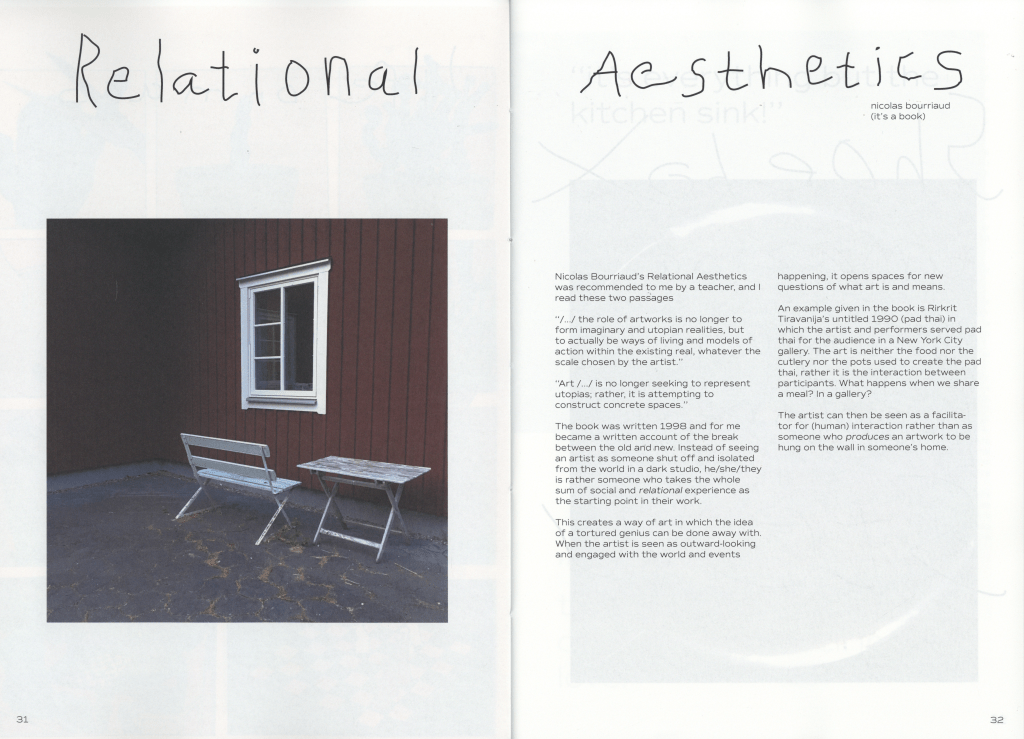
Art and culture and anti-elitism and inclusivity and openness. These are things that I believe in and hope to endorse. But when I spoke about art and Shoebox and Relational Aesthetics* to a friend of mine he told me it sounded like any other highfalutin art speak he’d ever heard. Statements like: Shoebox aims to be an open, inclusive and anti-elitist space, carry weight and the question is if we actually have the authority to issue them. Is Shoebox not in some ways already an embodiment of exclusion and elitism?
I like this excerpt from John Berger’s 1989 essay Miners:
I can’t tell you what art does and how it does it, but I know that often art has judged the judges, pleaded revenge to the innocent and shown to the future what the past suffered, so that it has never been forgotten. I know too that /…/ amongst the people such art sometimes runs like a rumour and a legend because it makes sense of what life’s brutalities cannot, a sense that unites us, for it is inseperable from a justice at last. Art, when it functions like this, becomes a meeting-place of the invisible, the irreducible, the enduring, guts, and honour.
At the same time, there are countless of people who would cringe at the over-politization of art and culture. Art for art’s sake – that’s what we should strive for because there is already so much shit going on. Art is the essence of being in which our souls meet.
Shoebox #2 has been a long process one hour here and one hour there. It’s back and forth – eclectic – but how else could something like Shoebox turn out? I hope the submissions included in this issue may reflect the questioning and contemplations of this introduction, that I know I am not alone in. Finally acknowledging that perhaps a participant in Shoebox #2 would despise an introduction like this. These are my thoughts and my thoughts only.
dennis farnsworth, shoebox
____________________________
first edition of shoebox click on photos below to view book reviews, interviews, thoughts, art, life. Contact us for questions or to be part in coming issues. SHOEBOX #1
Introduction to the 1st edition:
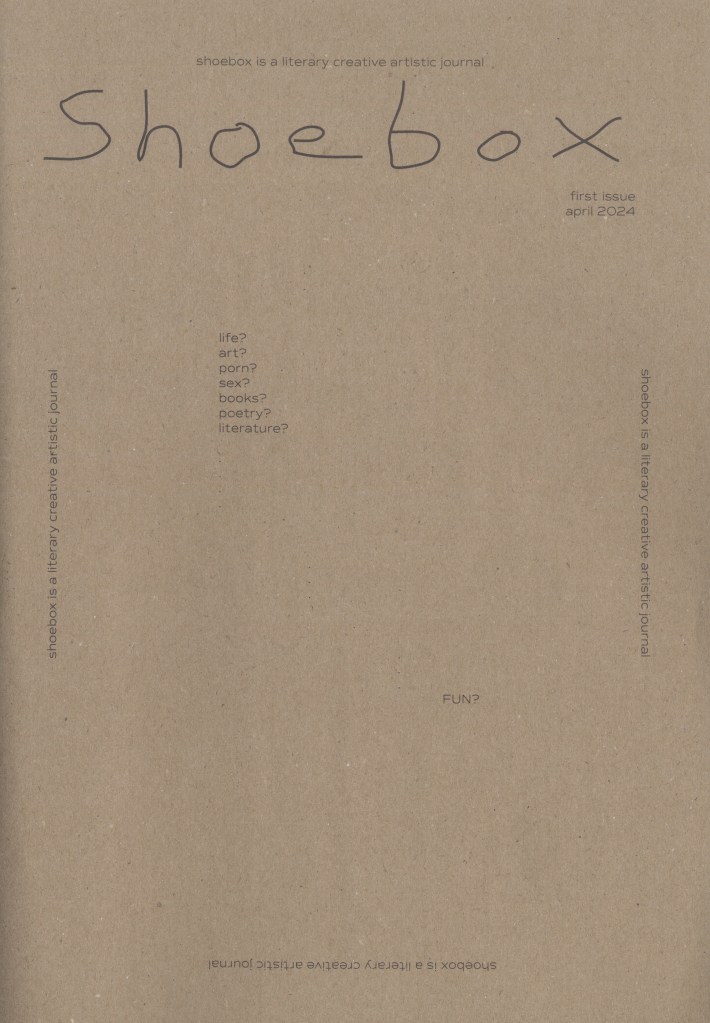
Shoebox is a magazine-publishing initiative started in 2023 by Dennis Farnsworth dedicated to fostering open dialogues, creativity and inclusivity in discussions centered around culture, art, political and social issues.
The first edition under the name magasin1 in 2023 was an exercise in gathering people, and creating an open anti-elitist space in which anyone can contribute and share thoughts. By also incorporating elements from world literature and history, linking it to the present, the issue became an attempt at conveying our similarities grounding it in art and various modes of expression.
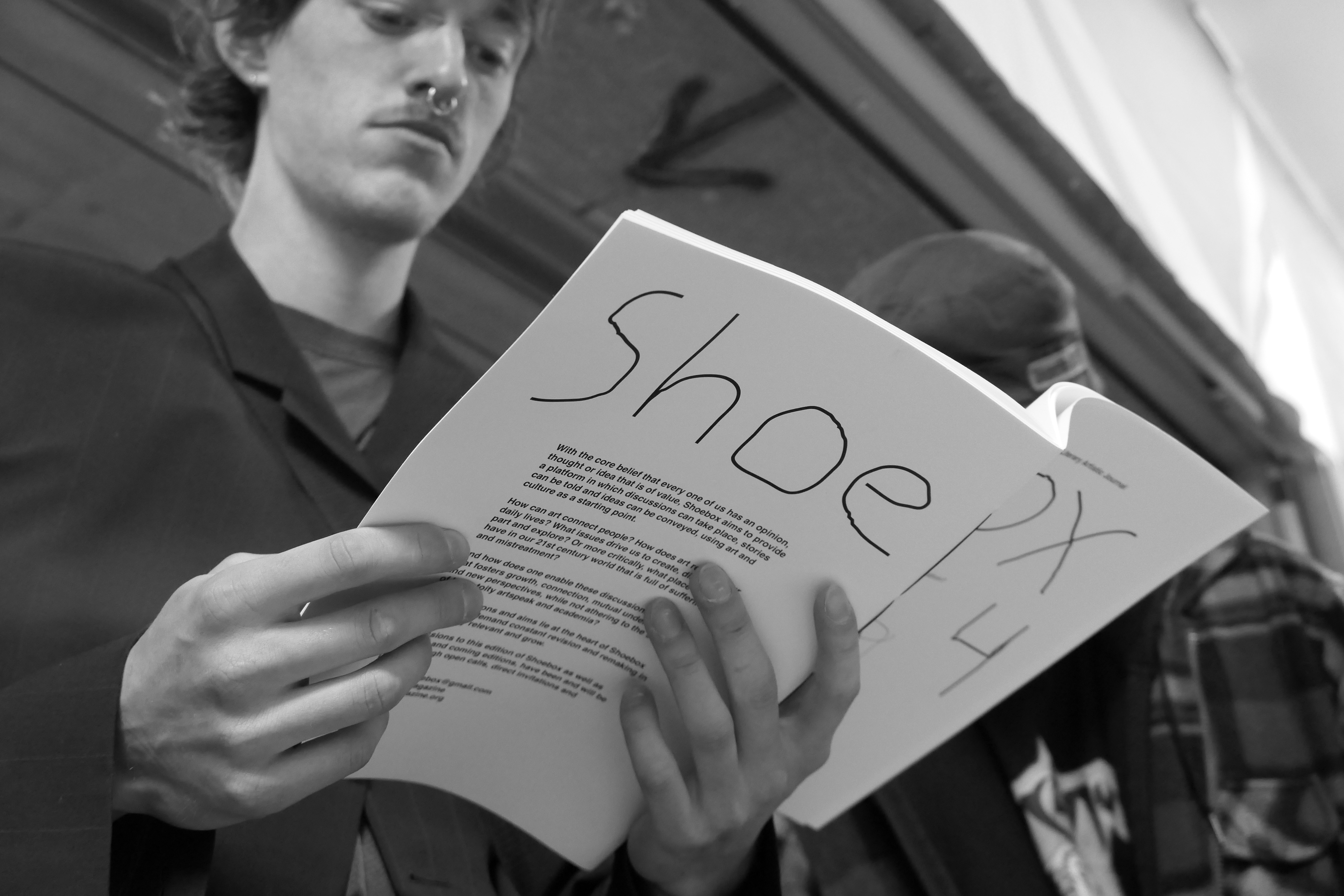
With the core belief that every one of us has an opinion, thought or idea that is of value, Shoebox aims to provide a platform in which discussions can take place, stories can be told and ideas can be conveyed using art and culture as a starting point.
How can art connect people? How does art relate to our daily lives? What drives us to create, discuss, take part and explore?
And how does one enable these discussions in a way that fosters growth, connection and mutual understanding, while not adhering to the stiffness of hoity-toity artspeak and academia?
These questions and aims lie at the heart of Shoebox and as such demand constant revision and remaking in order to stay relevant and grow.
As an example of how one can confront issues through language – art – I look to Steinbeck and the Grapes of Wrath for help:
There is a crime here that goes beyond denunciation. There is a sorrow here that weeping cannot symbolize. There is a failure here that topples all our success. The fertile earth, the straight tree rows, the sturdy trunks, and the ripe fruit. And the children dying of pellagra must die because a profit cannot be taken from an orange. And coroners must fill in the certificates – died of malnutrition – because the food must rot, must be forced to rot.
The people come with nets to fish for potatoes in the river, and the guards hold them back: they come in rattling cars to get the dumped oranges, but the kerosene is sprayed. And they stand still and watch the potatoes float by, listen to the screaming pigs being killed in a ditch and covered with quicklime, watch the mountains of oranges slop down to a putrefying ooze, and and in the eyes of the hungry there is a growing wrath. In the souls of the people the grapes of wrath are filling and growing heavy, growing heavy for the vintage.
Besides the aim of publishing four main issues per year by inviting artists and contributors through open calls Shoebox also works with self-publishing texts and essays. This works parallell to the broad-topiced main issues and enables in-depth discussion and freedom to stand on one’s own.
While the main language of Shoebox is English, we encourage anyone to write in the language they feel comfortable in. By translating the original to English (or not) and then publishing them side-by-side we hope to facilitate an inclusive and accessible space, tackle language barriers and cross our arbitrary borders.
 Shoebox Magazine